Answers with context.
Retrieve from approved documents and records, with source references that a person can inspect.
PRIVATE AI / BUILT AROUND YOUR WORLD
In your office. On your infrastructure. Alongside the knowledge that makes your business yours.
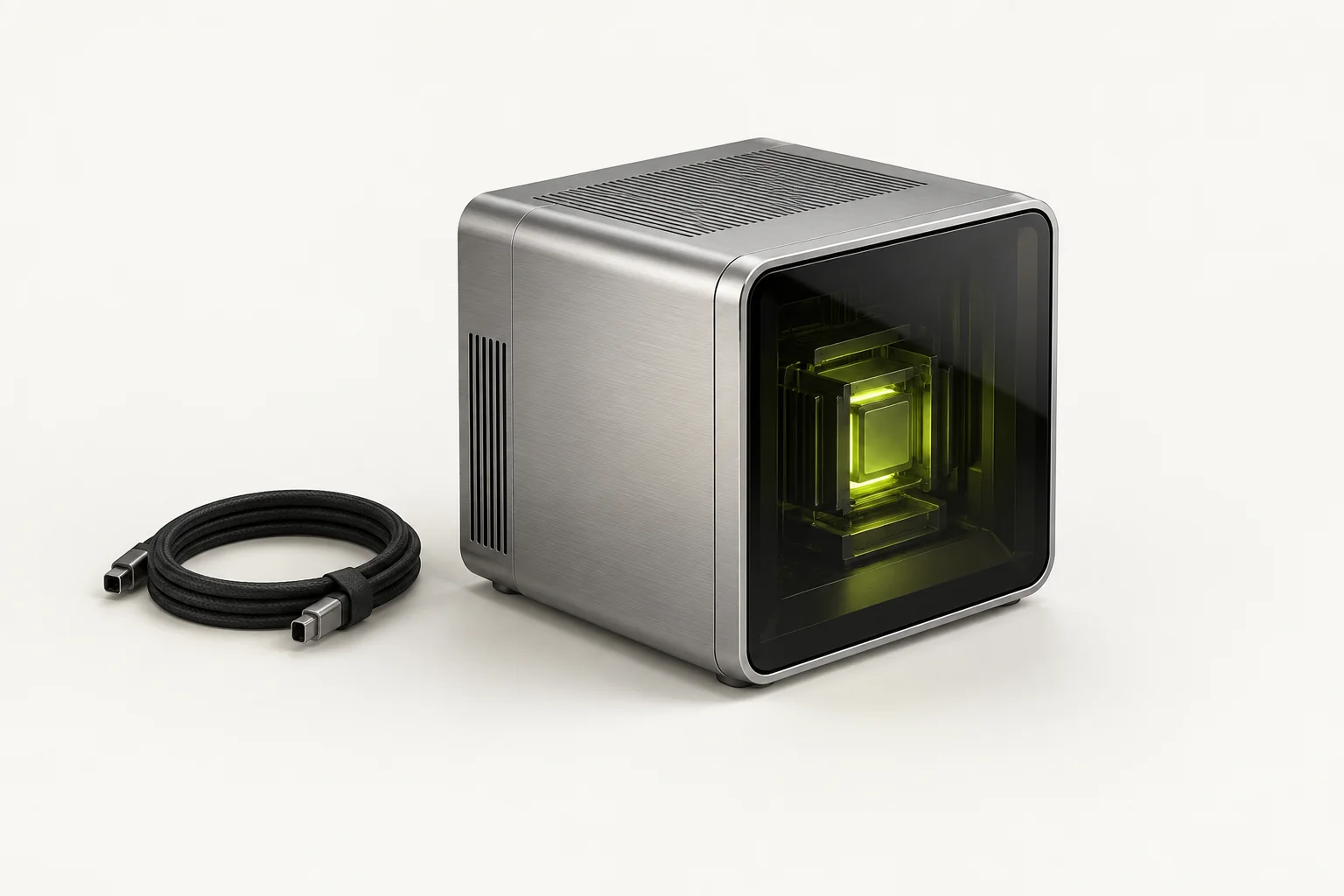
Open-weight models make it possible to put useful reasoning, document understanding, and assisted workflows inside an enterprise boundary. The right design connects the model to your knowledge, your permissions, and your existing software.
Retrieve from approved documents and records, with source references that a person can inspect.
Place model serving, embeddings, retrieval, and application services on infrastructure you operate.
Connect carefully scoped tools for service tickets, search, reporting, and reviewed operational actions.
FROM FIRST QUESTION TO DAILY USE
We consult, prototype, integrate, and operationalize. Begin with a real task and a representative evaluation set, then choose the model and hardware that meet it.
Choose users, workflows, accepted data, and what a correct answer or action looks like. Record the failure cases that matter.
Compare candidates on your tasks, license terms, supported languages, reasoning needs, context, and serving compatibility.
Package approved weights and runtimes, restrict network egress, configure storage, secrets, identity, and an internal inference endpoint.
Add retrieval, source references, scoped enterprise APIs, input validation, and approval checkpoints for consequential actions.
Test answer quality, permissions, prompt injection, latency, concurrency, memory, and recovery on the intended hardware.
Version prompts, adapters, and indexes. Monitor useful signals, apply retention rules, and keep a tested rollback and update process.
RAG / GIVE THE ANSWER A SOURCE
Retrieval-augmented generation connects a question to relevant passages before the model answers. It is usually the first move when a business needs current, attributable knowledge.
CONNECT
Start with manuals, policies, tickets, and product records. Capture document ownership, revisions, and access rules at ingestion.
PREPARE
Extract text and layout, split on meaningful boundaries, and create embeddings locally. Preserve page, section, and document identifiers.
RETRIEVE
Authenticate the user, apply document permissions, combine keyword and vector search, and rerank the best passages. Retrieve only within that user’s permitted scope.
RESPOND
Give the model the selected evidence and a clear response policy. Ask it to cite sources, distinguish missing facts, and decline an unsupported answer.
EVALUATE
Test grounded answers and permission boundaries. Track source freshness, delete superseded entries, and route uncertain questions to a person.
All stages can run locally. “Local” does not automatically mean isolated: we also review telemetry, external APIs, update paths, backup destinations, and who can access logs. Retrieval improves grounding; it does not eliminate incorrect answers.
ADAPTATION / MAKE IT FIT THE BUSINESS
Define the role, response format, examples, and boundaries. A fast first step for behavior you can express clearly.
Supply current documents and records at answer time. Use it for changing facts, source references, and permission-aware knowledge.
Train a compact adapter on curated examples to improve a repeated behavior, domain phrasing, or output structure. QLoRA reduces training memory through quantized base weights.
Reduce weight precision to save memory at inference time. It is a deployment choice to evaluate, not a way of teaching new company knowledge.
Brand voice brief Product: field gateway. Facts: local recording; resumes upload after reconnecting.
Our solution offers advanced features and excellent functionality for your enterprise.
Record where the work happens. Catch up when the connection returns.
A style adapter can learn preferred tone and structure. Product facts still come from approved records; a reviewer approves publication.
Structured service tickets brief Field note: Unit P-17 is vibrating. Started after yesterday’s restart. No temperature reading supplied.
The pump may need maintenance. Check the system.
Asset: P-17
Symptom: vibration
Onset: after restart yesterday
Missing: temperature, operating load
Next step: technician review
An adapter can learn a ticket schema and how to represent missing information. Schema validation and review still run outside the model.
Your engineering conventions brief Task: draft an internal API handler that updates a service record.
Generate a generic route handler with inline database access.
Use the approved service layer.
Validate the request schema.
Check the caller’s scope.
Emit the standard audit event.
Add the repository’s expected tests.
Repository examples can teach recurring conventions. Retrieval supplies current APIs; tests and code review decide whether a change is acceptable.
Illustrative, authored examples explaining the objective of adaptation. These are not live model outputs or measured fine-tuning results.
Our 2023 Merlin AI work adapted Llama for a branding agency using a custom corpus and LoRA. A modern engagement starts with authorized training examples, a held-out evaluation set, and a clear comparison against prompting and retrieval. We train only when the evidence supports it.
Explore named model comparisons, benchmark strengths, and the gaps that still matter.
02 / THE INFRASTRUCTUREFrom CPU and Mac mini experiments to GPU workstations and accelerator servers.